Assessment
Key Stage 3 Assessment and Reporting
We have moved to a five-stage system for assessing students’ progress towards the Age-Related Expectations (ARE). This system provides a clear picture of how each student is progressing in relation to the curriculum. Stages get progressively more challenging as a student moves through Key Stage 3. The five stages are:
● Beginning
● Working Towards
● Expected
● Working Above
● Greater Depth
The data report parents receive for their child shows the stage they have achieved in their most recent topic. This gives an indication of their current level of knowledge, understanding, and skills within that subject area. Over the course of the year, parents will receive three data reports which provide a snapshot of a student's ‘working at’ stage. Please note that a student's rate of progress may vary over time and may differ between topics.
Parents can cross-reference a child’s stage with the subject specific ARE Frameworks which can be found on the drop-down menus below, along with a video, which we hope will explain the report and the updates we have made to the KS3 ARE Framework.
Also found below are our descriptors for both Behaviour for Learning and Independent Learning. These provide clear explanations—written in language accessible to students—of what each descriptor looks like in practice, helping students understand how they can continue to develop their learning skills and behaviours.
Alongside the snapshot, at the end of the academic year, parents and carers will receive an overall stage for each subject, showing the level at which their child has ended the year. This will be a teacher's judgement, based on all of the evidence gathered throughout the year, including classwork, assessments, and verbal contributions to learning.
Key Stage 4 Assessment and Reporting
At Christ the King College, our assessment framework is rooted in our core values of Challenge, Aspiration, and Integrity. As our students move through Key Stage 4, we empower them to become "the best versions of themselves" by providing a clear and rigorous roadmap toward their GCSE and Vocational qualifications.
Our Approach to Assessment
In line with our mission to nurture the "whole person," we use two distinct methods to monitor and support student growth:
Formative Assessment
This is the "living" part of our curriculum. Through low stake quizzes, questioning, and feedback, teachers identify individual strengths and "areas for growth." This allows students to act with integrity in their studies, addressing gaps in knowledge as they appear. This will also include “live marking” which is the practice of a teacher assessing and giving feedback on students' work during the lesson. This not only allows students to act on feedback instantly but also prevents misconceptions from bedding in.
Summative Assessment
These are formal "milestone" evaluations, such as end-of-unit tests. These assessments allow students to demonstrate their aspirations by showing what they have mastered over a longer period of study.
Mock Exams
Preparation for external examinations is a journey of resilience and challenge. To ensure students feel confident and prepared, we conduct formal mock exams at the following stages:
-
Year 10: A full mock series at the end of the academic year.
-
Year 11: Two to three mock series to refine technique, stamina, and time management.
Data and Progress
We believe in fairness and transparency in our reporting. Three times per year, parents receive a data report featuring a "Working At" grade. This is a snapshot of the level a student is currently achieving based on their cumulative assessment evidence.
As students transition from Year 10 into Year 11, we introduce Predicted Grades. These are professional teacher judgements of the grade a student is likely to achieve at the end of the course.
Reporting
The reports typically include a section for each subject, it includes the following information:
-
Behaviour for Learning
-
Independent Learning
-
FFT Target*
-
On Track
-
Current Working Grade
-
Final Predicted Grade
The FFT Target is actually an estimated final grade for the subject, they are individual grades specific to each student, for example if a student has higher prior attainment in numeracy rather than literacy then certain subjects like Maths and Computer Science will likely be higher than English, Media or Film Studies. The grade is also based on what the top 20% of similar students achieved the previous year, making it an aspirational estimation.
Measuring if a student is “on track”
To foster high aspiration, we compare student progress against FFT 20 estimates. These are ambitious benchmarks based on the progress made by the top 20% of students nationally.
-
On Track: The student is meeting or exceeding these high-reaching estimates.
-
Not On Track: The student may need additional support or a renewed focus on their "Behaviour for Learning" or “Independent Learning” to reach their full potential.
Other Data
Our reporting goes beyond academic figures. We continue to report on “Behaviour for Learning” and “Independent Learning”, reflecting our commitment to the Christ the King Way. These scores remind students that academic success is inextricably linked to the Christian ideals of hard work, respect, and personal responsibility. They are recorded as:
-
A- Outstanding
-
B - Good
-
C - Requires Improvement
-
D - Cause for Concern
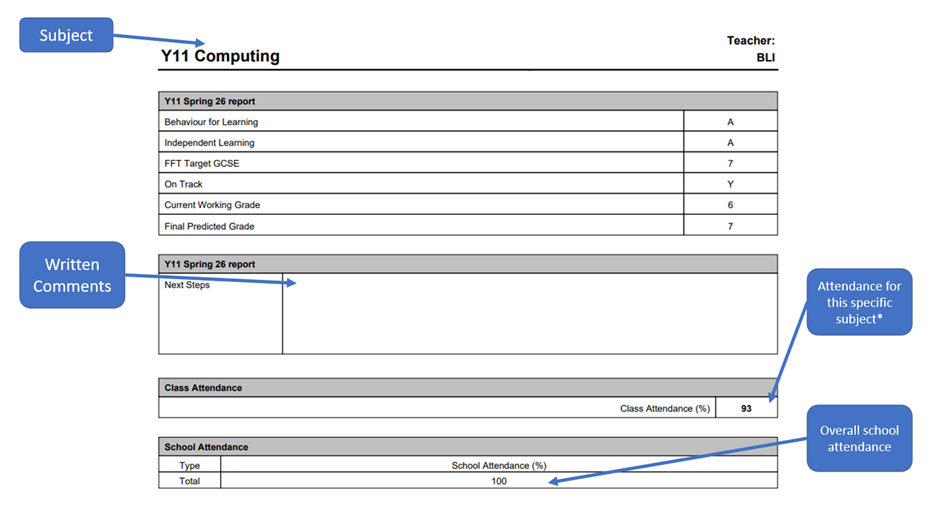
*This will be different from the School Attendance because if a student misses a lesson due to a school trip they are absent from the lesson but not from school.
Assessment Framework
Year 7 Autumn Data Report
Year 7 Spring Data Report
Year 7 Summer Data Report
Year 8 Autumn Data Report
Year 8 Spring Data Report
Year 8 Summer Data Report
Year 9 Autumn Data Report
Year 9 Spring Data Report
Year 9 Summer Data Report
Understanding the revised ARE framework at KS3 (MP4 file)
Understanding the revised ARE Framework at KS3